

Set-valued functions (SVFs) are an important tool for modeling problems with uncertainty in the data. Function or parameter values that are not known exactly can be replaced by sets of possible values, thus leading from real-valued functions to set-valued ones. SVFs are also used when the underlying data are exact but are themselves sets. Applications arise in various fields, including:
Geometric modeling - the reconstruction of 3D objects (2D shapes) from a finite number of their 2D (1D) parallel cross-sections. The object (shape) may be regarded as an SVF, the given cross-sections as its samples. Such an approach may be applied in medical imaging.
Parametric optimization - in these problems the set of non-unique minimizers depends on the value of the parameter, thus defining a SVF of the given parameter. These problems exist in various branches of industry, economics and sciences.
Dynamical processes - if in a differential equation the right-hand side is not known exactly, it is replaced by the set of possible values, and the differential equation is replaced by a differential inclusion. Such dynamical processes may arise in physics, chemistry, engineering, biology and sociology (e.g.in population dynamics and demography), economics. The solution of a differential inclusions defines an SVF.
Examples of set-valued data.
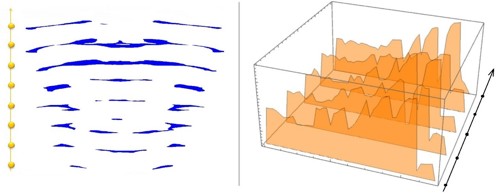
We seek an approximant over the whole domain
Aims of the project
The Aumann set-valued integral is widely used, but it is always convex, regardless of whether the images of an SVF are convex or nonconvex. We introduced another notion of a set-valued integral—the metric integral. This research studies properties of SVFs with 1D images and develops methods for computing their metric integral.
The concepts of tangency to a set and graphical derivatives are central to approximation, control, and optimization. We study different notions of tangent cones and associated derivatives, with the aim of introducing new notions of these concepts.
A differential calculus of SVFs plays a significant role in various areas. The research aims to extend our previous work on metric derivatives and local linear approximants of univariate SVFs to multivariate SVFS, and to generalize these concepts to higher order.
Project members
Dr. Robert Baier, Department of Mathematics, University of Bayreuth, Germany.
Dr. Elza Farkhi, School of Mathematical Sciences, Tel Aviv University, Israel.
Prof. Nira Dyn, School of Mathematical Sciences, Tel Aviv University, Israel.
Prof. David Levin, School of Mathematical Sciences, Tel Aviv University, Israel.
Analysis and approximation of set-valued functions
Share a link using:
https://external.afeka.ac.il/en/afeka-news/magazine/analysis-and-approximation-of-set-valued-functions/WhatsApp
Facebook
Twitter
Email
https://external.afeka.ac.il/en/afeka-news/magazine/analysis-and-approximation-of-set-valued-functions/